.png)
If you’re an AI expert, or even someone who’s experimented with tools like LLMs, you’ll know that models are the foundation of every AI application. They determine exactly how an AI system interprets data, identifies patterns, and generates predictions or recommendations. To put simply, models are the foundation of AI.
This is no different for VRIFY Predict’s DORA software for AI prospectivity mapping. DORA uses Foundation Models to make predictions based on both geospatial and augmented exploration data within the software’s iterative workflow. This means it’s straightforward to test different Foundation Models against the same exploration data, compare the results, and explore multiple hypotheses before deciding which approach best supports your targeting and exploration strategy.
In this article, we’ll cover exactly what Foundation Models are and which exist within DORA, how they were developed and trained, how to select the best model for your project, and how they support exploration.
What are Foundation Models?
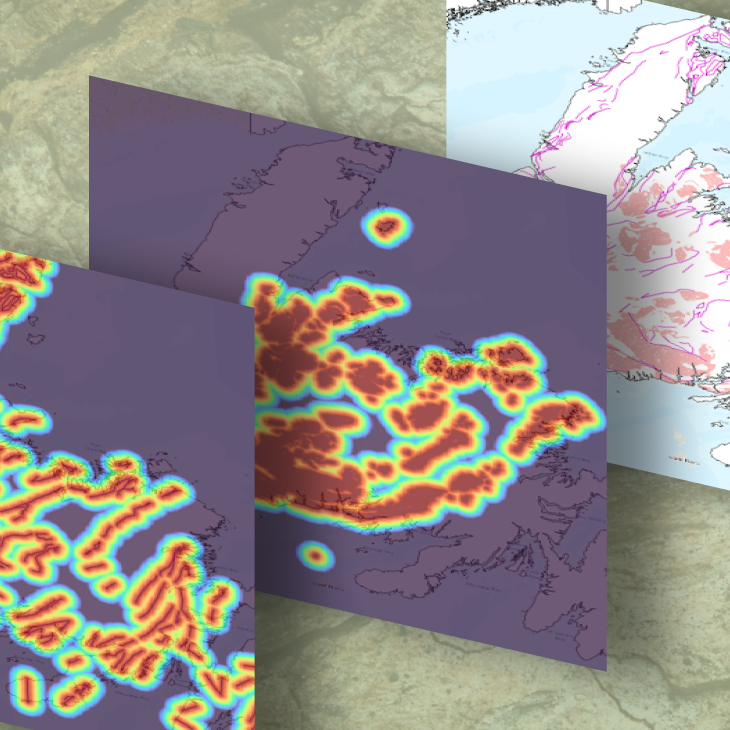
In machine learning, foundation models are specialized deep learning models trained on massive data sets. In DORA, our Foundation Models analyze anonymized geospatial data to identify patterns associated with known mineral deposits and are used to generate Prediction Maps.
How are VRIFY’s Foundation Models developed and trained?
VRIFY’s Foundation Models are pre-trained on globally sourced, anonymized datasets covering a wide range of geological environments and deposit types — more on data anonymization and security here. Training is led by our multi-disciplinary research and development team and involves feeding the models large batches of geospatial data repeatedly, allowing it to refine its understanding of geological patterns across many iterations. This means DORA’s Foundation Models encompass established knowledge of geological and statistical relationships before your project data is introduced, allowing the model to use context to interpret your data stack rather than simply process it. This is similar to when an experienced geologist has a deep understanding of a deposit or district and then is able to apply it to another exploration area. Though the rocks are different, the patterns and relationships hold true.
Each deposit-specific model is trained on datasets curated for that mineral system, so its understanding of the patterns reflects the footprints and associations of that deposit type. The Deposit Agnostic Model is trained across all deposit types and the Custom Model is not pre-trained.
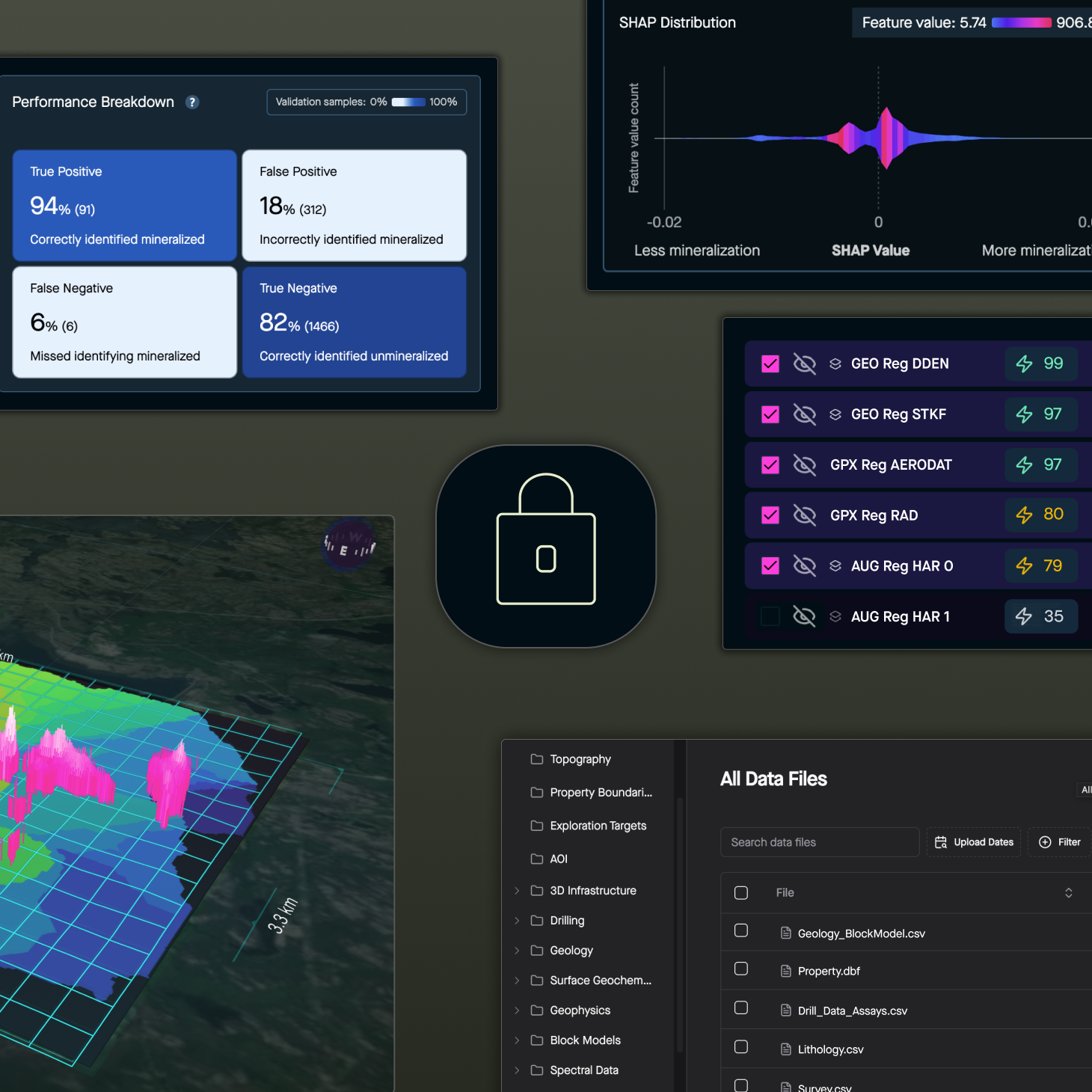
Across the Foundation Models, training comprises more than 250,000 snapshots of exploration data spanning 11 deposit types, with substantial variation in dataset size and class balance. Because these datasets are inherently class imbalanced, this is accounted for during training and evaluation to prevent performance from being dominated by the unmineralized class. Performance is then assessed using accuracy, F1 score, precision, recall, classification loss, and reconstruction loss, rather than accuracy alone. F1 score is particularly important because it balances precision and recall, while precision measures the reliability of positive predictions and recall measures the model's ability to identify true deposit occurrences.
Across the 11 Foundation Models, average accuracy is 85.9% and F1 score is 74%, providing complementary measures of overall and class sensitive performance.
One of DORA's key advantages is its iterative workflow. If you begin by using one Foundation Model but later want to test a different approach or compare results, you can easily re-run your experiment using a different model. This flexibility makes it easy to explore multiple hypotheses and build confidence in your targeting decisions.
Which Foundation Models are available in DORA?
Within DORA, there are 10 deposit-specific Foundation Models, each trained on global datasets from similar deposit types. In addition, users can choose from a Custom Model or a Deposit Agnostic Model. The best model depends on your project, deposit type, and understanding of the local geology. Running multiple experiments across different models can help deepen your understanding of the deposit and identify opportunities for mineralization beyond what is already known. Results derived from different Foundation Models can be compared within the software to drive further understanding.
- Arch Intrusion Related Au-Cu
- Deposit Type: Archean intrusion-related deposits
- Target Commodities: Au, Cu
- Carlin Au
- Deposit Type: Carlin-style deposits
- Target Commodity: Au
- Epithermal Au
- Deposit Type: Epithermal-hosted gold deposits
- Target Commodities: Au
- Epithermal Polymetallic
- Deposit Type: Epithermal poly-metallic
- Target Commodities: Au-Ag-Cu-Pb-Zn
- Orogenic Au
- Deposit Type: Orogenic gold deposits
- Target Commodities: Au
- Pegmatite LCT
- Deposit Type: Pegmatite LCT-hosted lithium deposits
- Target Commodities: Li
- Porphyry Cu-Au-Mo
- Deposit Type: Porphyry-related deposits
- Target Commodities: Cu, Mo, Au
- Ultramafic Hosted Cu-Ni-PGE
- Deposit Type: Ultramafic hosted Cu-Ni-PGE
- Target Commodities: Cu-Ni-Co-Pt-Pd
- Unconformity Related U
- Deposit Type: Unconformity-Related Uranium
- Target Commodities: U
- VMS Polymetallic
- Deposit Type: Volcanogenic Massive Sulphide (VMS) deposits
- Target Commodities: Au, Cu, Zn
The Deposit-Agnostic Model is trained across multiple deposit types and can be used when there’s uncertainty about the mineral system classification. Further, it can be useful to apply when learning general geoscientific representations rather than the signature of a single deposit type.
When a project does not align with any of the available Deposit-Specific models, the Custom Model provides a flexible alternative. Unlike the deposit-specific Foundation Models (which are pre-trained on large, diverse datasets) the Custom Model is trained entirely from scratch using only the data within your selected Area of Interest (AOI). This approach is ideal for deposits with unique geological characteristics or mineral systems that are not well represented by the existing Deposit-Specific models. The Custom Model is also well suited to projects with large volumes of high quality, representative data, allowing the model to learn patterns that are specific to the project without relying on knowledge transferred from broader datasets.
How do I select the best Foundation Model?
With three Foundation Model types to choose from in DORA — deposit-specific, deposit-agnostic, and custom — expertise from your team will be required to select the best model for your project. Ultimately, model selection depends on your project geology and knowledge of the target mineral system.
Deposit-Specific
These models have a deep understanding of the patterns and relationships found in exploration data for the specific deposit type they were trained on. They are best used when a project fits a recognized deposit type. Each deposit-specific Foundation Model tends to reflect the geometric expression of its deposit type.
Deposit-Agnostic
Trained across multiple deposit types, this model carries no bias toward a specific deposit type or commodity It is best used when there is uncertainty around the mineral system and a second perspective, unconstrained by assumptions, is desired.
Custom
Using only project data within a specific AOI for training, the Custom Model is best used when a project doesn’t fit a recognized deposit type or when geology of a project is distinct enough that prior training on other environments could introduce noise versus signal.
One of DORA's key advantages is its iterative workflow. If you begin by using one Foundation Model but later want to test a different approach or compare results, you can easily re-run your experiment using a different model. This flexibility makes it easy to explore multiple hypotheses and build confidence in your targeting decisions.
How does this help me?
Think of Foundation Models as a head start in prospectivity mapping. Trained on massive global datasets that are often inaccessible to the public, these deep learning models provide a richer geological understanding of the data from the outset. As a result, DORA can generate more accurate prospectivity maps and identify higher-confidence targets. Essentially, Foundation Models help you start from a stronger geological baseline.
<hr />
To learn more about Foundation Models and how they support target discovery in DORA, book a demo: https://vrify.com/ai-demo
.png)
.png)
.png)


.jpg)
.png)